


[03]
2025
Project
[Design]

Side-Assembled View
Illustrative concept to demonstrate methods; parameters are intentionally generic. Any resemblance to real designs is coincidental. Content policy: T&Cs.
[03]
2025
Project
[Design]

Semi-Assembled View
Illustrative concept to demonstrate methods; parameters are intentionally generic. Any resemblance to real designs is coincidental. Content policy: T&Cs.
[03]
2025
Project
[Design]

Power Generation Model
Illustrative concept to demonstrate methods; parameters are intentionally generic. Any resemblance to real designs is coincidental. Content policy: T&Cs.
Power Generation
[03]
2025
Project
[Design]


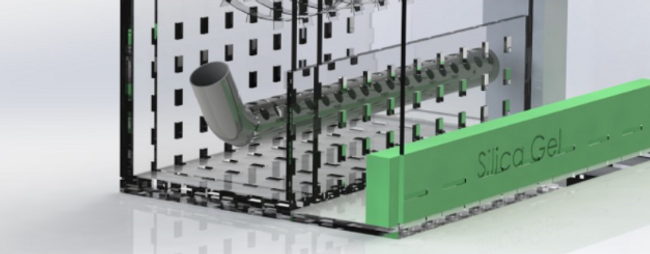


Range of Visal Facets and Variations of Project.
Illustrative concept to demonstrate methods; parameters are intentionally generic. Any resemblance to real designs is coincidental. Content policy: T&Cs.

Power Generation: Project Eva-Power
Engineer a scalabel, cubic-meter module that transforms hydration–dehydration cycles in hygroscopic cellophane into continuous mechanical rotation and reliable micro‑power generation.It relies on hydration and dehydration cycle of moisture-absorbing cellophane material; a hygroscopic material that has nanoscopic confinement of water.
Working Details
Evaporative Energy Capture: Exploited humidity differentials between a water reservoir and ambient air within a sealed chamber; weighted cellophane strips cyclically contracted and expanded to drive a central shaft. System tuning leveraged psychrometric modelling to optimise chamber ventilation rates, maintaining a stable humidity gradient even during day‑night swings.
Output: Modular 1 m³ units, each stacking 16 sub‑assemblies, provided ~1.3 W at a cost roughly triple pre‑scale solar. Extended field trials confirmed continuous power in 70–95 % RH climates and incorporated passive damping to prevent overspeed in tropical environments.
Rotor Assembly: Ten hygroscopic wheels on a common shaft produced ~78.9 mN of torque, delivering smooth rotational motion for micro‑generation. Carbon‑fibre shafting with low‑friction ceramic bearings curtailed drag, and an adjustable cam permitted torque scaling to match diverse electrical loads.
Prototyping & Materials R&D: Built multiple prototypes via SLA/SLS printing; micron‑precision laser‑cut cellophane and tested B. subtilis spore films achieving tensile responses 10× self‑weight. Comparative studies with PET, nylon, and cellulose‑xanthan blends verified cellophane’s superior cyclic durability over 50 000 actuation cycles.
FEA Validation: Applied Ansys multi‑physics to model humidity diffusion and coupled strip actuation, verifying wheel kinematics and friction losses. Correlation with high‑speed videography exhibited <4 % error in predicted angular velocity, underscoring solver accuracy
Tools and Skillset
SLA & SLS additive manufacturing
Precision laser micro‑cutting
Ansys FEA humidity‑coupled analysis
MATLAB friction‑loss modelling
PLC micro‑harvester circuit design
CNC machining & DFM practice
Embedded C programming
Team leadership


